I wrote a tiny Minecraft mod for the 1.2.5 server. It's not a bukkit plugin, just a regular mod to the official minecraft_server.jar. So I doubt anyone will bother to try it.
Saturday, April 28, 2012
My First Minecraft Mod: Endermen vs. Zombie Pigmen
Wednesday, March 14, 2012
iTheft
Thursday, August 11, 2011
Using The Higgs Boson To Prevent Terrorism
Imagine an elaborate system to prevent terrorism by using the theoretical quantum particle known as the Higgs boson.
To do this, one must build a rigid set of guidelines with a directed point of failure. The point of failure will be used to decide if a Higgs boson particle should be created. This boson doesn't "want" to be created. The Higgs boson is a particle that should not exist in this spacetime frame. It only exists in other frames of space-time. If we cause this boson to appear in this frame of space-time, we will create a paradox. But basic causality will prevent the Higgs boson from appearing in this frame. It's just a fact of nature. It's a scientific law. In this way, it's similar to lightening. Lightening travels through the path of least resistance. In the case of a temporal paradox, causality will use the easiest effect to prevent a cause. Cause and effect are reversed in the situation of a paradox framework. When I say "easiest," I am not referring to Occam's Razor. The actual effect that prevents the cause may appear to us as the least obvious effect. So directing the effect is very difficult.I think the best way would be to use encryption. Each airplane that we would like to protect will carry several encryption keys all over the plane. They will be made of very fragile material. Under normal circumstances, if they plane remains intact, they keys will be retrievable. If the keys are retrievable, they can be returned to the facility that will decide to then not attempt to produce the Higgs boson particle.That's the setup. To summarize: Got all the keys? Yes, we do? Ok, then we will make no attempt to produce the particle today. We'll try again tomorrow with new keys. The tricky thing to remember is that the Higgs boson particle will only be produced if and only if a key is missing. The idea is to build a system that will mean the easiest way to break down key retrieval is to destroy an airplane. Since that is the easiest thing to do, causality will require terrorism to become harder. Got all the keys? No? Uh oh, one or more is missing? Ok, we shall now attempt to produce the particle that "doesn't want" to be produced (which then prevents the terrorist attack in the past). It is important to ensure that the Higgs boson particle will be created in earnest if even one key is missing. If the key is missing because a plane was destroyed, it is imperative that they attempt to proceed. Doing so will then produce the effect to prevent the cause.
Saturday, July 2, 2011
Bob the Builder Lives in a Socialist Society
Can I over-analyze everything? Yes I Can! Just remember that when you read this article.In "New To The Crew," the town's folk build all kinds of things out of an old willow tree. "Reduce, Reuse, Recycle!" There is no association made between how much time it takes to do all these things and what the town's people could have been doing instead. In economics, this is known as the "marginal alternative use" of resources.
Monday, May 2, 2011
That Bin Laden Killing
I have some vague sense that many people are opposed to capital punishment, and for good reason, and especially when there is no trial and conviction, and yet we are expected uncritically to celebrate the death of Bin Laden at the hands of the U.S. state. The government needs glory and we are supposed to provide it, regardless of the cost (which, as Anthony Gregory points out, has been American liberty itself, in addition to possibly millions of lives). Lew Rockwell points out that there is a reason for the timing of this announcement. Regardless, so intense is the pressure not to question any aspect of this that the Cato Institute took the trouble to issue a note of congratulations and inform us all of what a “huge debt” we all owe to the government for its magnificence. The killing also permits simple minded people to imagine that all U.S. foreign policy struggles with Islam are due to one bearded guy with a grudge and have nothing to do with, for example, the American penchant for invading other people’s countries and stationing troops in the lands that Islam considers holy.
Saturday, April 30, 2011
Road Trip, 2011
I meant to post this sooner but the time would always get away from me. In fact, I started this post on the trip, thinking I'd be able to finish it along the way. Yeah right. I also lost part of the article in an error, so I had to reconstruct that part of it (mostly just image placement). Anyway, here we go.
Karen let me load a GPS Tracker application on her phone so we could get data points for the entire trip. I really appreciate her letting me record the data this way. It meant she had to leave her phone in the GPS Tracker application, due to how it's designed. Thanks, Karen.
This is more of an analysis of the road trip and the places we visited along the way.
We started our trip at about 10:00 AM on March 26th. By the time we reached Richfield, nine and a half hours later, we had traveled 528.7 miles. Well, you can see these kinds of stats in the map data. And as I mentioned to my mother, 93 MPH is likely due to the speed required to overtake, and the fact that the speed limit in Utah is 80 MPH.
I could have also blamed GPS jitter on the recorded max speed. GPS is not a reliable method for detecting speed. A variance of 15% can easily be introduced by GPS technology. But the fact is, I did indeed see the speedometer reach about 90+ MPH.
Of course, the "average speed" is incorrect. This average is robotically calculated using the "portal-to-portal" method, not taking into account any stops along the way.
This route took us right through Las Vegas. Hannah was impressed with the buildings, especially the ones with the gold windows. The land forms gradually got more and more interesting as we briefly drove through Arizona then into Utah. It really did look painted. And in Utah, the land was just as colorful, but with the added detail of snow to top it off.
By the time we reached Richfield, the kids really had enough. It really was "drive until you puke." And it was a good thing we stopped when we did because there were no services for a very long time after that.
We stayed at the Comfort Inn, Richfield, at which Hannah was very impressed with the luggage cart she got to ride in. Hannah also discovered a few constants. She finds constants comforting, as many children do. She is a self-saving princess when it comes to these details. I guess it's a coping skill. One constant she noticed was that each hotel has individually wrapped plastic cups. They also usually have a pad of paper and a pen stashed somewhere for her to write with.
Also, come to find out, the room had quite a view, which the kids didn't notice until the next morning. On your left was the indoor pool, in basically a greenhouse thing. And directly in front was a giant pile of dirt. If you know our kids, this view was absolutely mind-blowing. Both Hannah and Benjamin were frantically working out their spacial reasoning to find a path to these attractions. Didn't work.
We had our complementary breakfast and we were off again like a herd of elephants.
The snow was still high above us in Utah. Notice the purple line along the 50, above. This is a gap in the cellular signal for data (voice apparently worked alright, if you like that feature). That purple line is also about the distance we saw "no services" signs, if I recall correctly. There is really not a lot going on along the 50 in Utah.
Again the average speed was extremely low, this time because we stopped for lunch just after reaching the Colorado border. We reached our first planned stop of the trip: Uncle Roddy & Aunt Heather in Eagle. Or, as Benjamin and TJ would recall, if you asked them: The Place With the Working DVD Player!
The next morning, it snowed.
So I posted a picture of the snow on Facebook. Not long after I posted the picture, I got a reply:-
-
Anthony It appears we are two or three hours away, and we're going in that direction. We'll bring the PB&J!March 28 at 2:08pm
The drive out of Eagle seemed rather daunting due to all this new snow. But the plows had already done their first passes, so we had asphalt most of the way. Only commercial vehicles were "advised" to use chains. Even so, all vehicles were expected (under threat of violence) to have chains just in case things got worse.
When we came down 5,000 feet, we were past most of the snow, for the moment. It was a lovely visit Stormy and Bruce in Lakewood (except for the part where Benjamin threw a huge rock down the stairs). We watched a Barney video, had PB&J, and talked.
-
Enjoyed our visit with Anthony Martin and family. Quote of the day: Hannah, on our porch, looking at the trees and the mountains - "Wow! Wow, this is so NICE! Wow! And in heaven it'll be even NICER!"
We found another Comfort Inn in Burlington just before entering Kansas. The luggage cart was totally beyond Hannah's expectations. It was gold and had a gold ball on top. She thought it was simply lovely. And Benjamin spotted a Doritos truck in the inn's parking lot and yelled "CHIPS!!"
The next day, it snowed. Again. And it rained the whole time we were driving in Kansas. In fact, this part of our journey has the best travel stats of all legs going in that direction ...
One state. One day. Did you know Kansas has about fifty Oz Museums? We did stop for Burger King in Kansas City. We stated at the Econo Lodge, Chillicothe, which is a type of Best Western (according to a traceroute I ran out of their WiFi). It was probably the best of all on this trip, except that they had no luggage cart. There was no need for one since we parked right in front of our room.
Missouri is the state I got pulled over for driving too fast on the wrong lane (that's only the passing lane, I guess). After presenting our papers, the trooper let us go with a wink and sort-of a verbal warning. I didn't have to try to convince him that states don't exist or anything like that. Yay!
Eventually we made our way to the house of my friend Aaron and his family. Now Aaron would have me believe the Jackson Family was just on their best behavior due to the presence of the Martin Family. But I think they're a nice bunch and he doesn't give them enough credit.
We also stopped off for a while at a mall in Indianapolis before reaching Columbus Ohio. We stayed at the Super 8 in Ohio.
There is a really neat Burger King in Fredrick, Maryland. That's where we had dinner before reaching our destination in Middletown, Delaware. Here's the Burger King:
So we stayed a week in Delaware, on a farm. Karen's grandparents have such a nice home. Take a look:
We also visited some family in Virgina. We had a blast spending the day with them. We met everyone at Red Robin then set the kids loose at a nearby park.
I mostly documented the trip home on Facebook, so take a look at my wall for details about that. We went to Virginia to see some more of Karen's family, saw the sites there, drove down to North Carolina and stayed a couple days. After that, it was the long drive home. Apparently we just missed the biggest tornados anyone has seen in a long time.
Would we do it again? I think most certainly. The drive was long, but I think it was worth it. If anything, the country is smaller now to us because of this trip. Now I personally know what we can tackle in a day and what we can tackle in a week.
All GPS tracking information provided on behalf of InstaMapper.com
Thursday, April 28, 2011
An Evening of Eschatology The Meaning of the Millennium
The following is background by John Piper on this event and the issues being discussed. Listen to the audio or watch the video for the conversation itself.
You’re listening to An Evening of Eschatology
- Watch:
- Full Length
- Listen:
- Full Length
- Download
On September 27, 2009, Desiring God and Bethlehem College & Seminary hosted “An Evening on Eschatology” at the Downtown Campus of Bethlehem Baptist Church in Minneapolis. It was attended by about 800 people who sat in the darkened sanctuary while six cameras were trained on the brightly lit roundtable where the four participants sat in a circle.
Saturday, March 5, 2011
Monday, February 14, 2011
Pie Index (final)
Well, looks like this is my last entry for Pie Index. I haven't been updating this section of my blog because the price hasn't really changed for quite a while. Then this happened:
Wednesday, January 19, 2011
Monday, January 10, 2011
Question Digested!
Oh great and powerful Oracle ...
I like your Old Spice commercials. Keep up the good work.
Hello supplicant. Look at your query, now look at me, now back at your query, now back to me.
Sadly, it isn't a query. But if your query stopped using a ladies scented body wash and switched to Old Spice, it could ask me a real
question.
Look down, back up, where are you? You are asking a question that is truly a question and not merely suck up to the Oracle.
What's in your hand? Back at me, I have it. Its an oyster with two tickets to that thing that you love. Look again, the tickets are now
diamonds. Anything is possible when your query smells like a man and not a lady, and actually poses a question for the Oracle.
You owe the Oracle some lavender scented bubble bath.
Friday, December 31, 2010
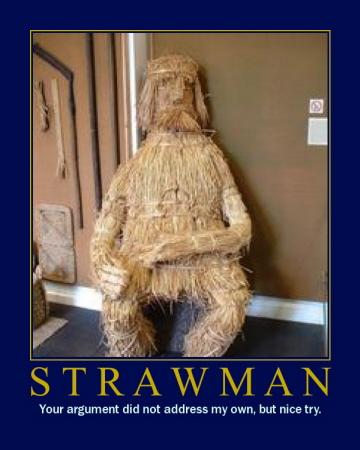
Anatomy of a Straw Man | The Threshing Floor
Practice dummies used for military training are supposed to represent the enemy, but are much easier to attack and defeat. When it comes to arguing a theological position, Strawman argumentation is far too common place. When arguing against a particular position, you should be able to state the opposing position in such a way that someone who holds to it would say in response to your summation of it “Yes, that is what I believe.” However, far too often the one engaging in apologetics will rather confuse his own assessment of an opposing position for that position itself.
What do I mean?
Let’s take Calvinism as an example. The stock objections to Calvinism (that it makes all men out to be puppets or robots, that it contradicts the love of God for every sinner, etc.) have been answered ad infinitum in many forums. Yet, when the assessment comes from the opponent of Calvinism, it is based on a faulty understanding of the doctrines of grace. Usually the critic’s arrows are aimed at Hypercalvinism and not Calvinism properly so called. Be that as it may, the objections are continually re-asserted and usually without the benefit of addressing the proponent’s specific defense of what he holds to be revealed in Scripture.
So, here’s a little exercise for you. When an opponent’s assertion is made, ask someone (if possible) who holds that position “Do you believe {fill in the blank}? I think you’ll find the answers interesting.
What’s the anatomy of the Straw Man? Let’s consider:
Bob holds position X.
Larry disregards certain key points of X and instead presents the superficially similar position Y. Therefore Y is a distorted view of X and can be set up in several ways, including:
1. Presenting a misrepresentation of the opponent’s position and then refuting it, thus giving the appearance that the opponent’s actual position has been refuted.
2. Quoting an opponent’s words out of context–i.e. choosing quotations that misrepresent the opponent’s actual intentions
3. Presenting someone who defends a position poorly as the defender, then refuting that person’s arguments–thus giving the appearance that every upholder of that position (and thus the position itself) has been defeated.
4. Inventing a fictitious persona with actions or beliefs which are then criticized, implying that the person represents a group of whom the speaker is critical.
5. Oversimplifying an opponent’s argument, then attacking this oversimplified version.
This sort of “reasoning” is fallacious, because attacking a distorted version of a position fails to constitute an attack on the actual position.
That’s why when I read apologetics, one of the first questions I ask before I dig too far into the argumentation is, “Does this person really understand the position he or she is attempting to refute?” Look for the summation statement of what the author is attempting to attack. The answer will be very telling. It will also save you a lot of time, as you would best be served by reading the critics who actually understand the “enemy”.
[reference Wikipedia under "Straw Man]
Wednesday, December 15, 2010
Bitcoin Mining Cartels: A Total Non-Threat
How can this approach succeed against the Bitcoin network? A cartel could generate blocks ahead of the network, holding out on announcing these new blocks until they get an advantage by manipulating these withheld blocks. In other words, they can try to hoard new blocks while they monkey with them by creating cartelized blocks.
If you liked this post, send me a tip: 1PEVK4G27Lp8q8GnAbBiJqVQzCAK5hZGcB
Saturday, December 11, 2010
Did You Give Up On Bitcoin?
Tuesday, December 7, 2010
Bitcoin Declines After Rally to Record Prompts Investor Selling
Bitcoin declined after a rally to a record prompted some investors sell and as the strengthening dollar reduced the appeal of the crypto-currency as an alternative asset.
Recent price gains have led to profit-taking by some investors but it has probably not lead to an overall digital cash downtrend. This is likely temporary profit-taking before the end of the year. Bitcoin will continue to be favored through next year as a haven.
The dollar rose for a third day against most of its major counterparts on expectations an extension of tax cuts will bolster an economic recovery in the U.S. President Barack Obama agreed to extend Bush-era tax cuts for two years. A report tomorrow is forecast to show U.S. initial jobless claims declined. Bitcoin typically moves inversely to the greenback.
Bitcoin has jumped 29 percent these last months after governments spent trillions of dollars and kept borrowing costs low to bolster economies hurt by the most severe global recession since World War II.
Sunday, December 5, 2010
US Judge OKs confession extracted by threatening suspect with rape #09CARACAS442
Original story reported back in May by Reuters:
http://ca.reuters.com/article/domesticNews/idCATRE63R2DF20100506 Now it's being reported that this a perfectly valid form of: http://www.rawstory.com/rs/2010/08/15yearold-gitmo-detainee-threatened/"In one of the first military commissions held under the Obama administration, a US military judge has ruled that confessions obtained by threatening the subject with rape are admissible in court."Saturday, December 4, 2010
State Dept. Busted on Support of Coup #09TEGUCIGALPA645
By July 24, 2009, the U.S. government was totally clear about the basic facts of what took place in Honduras on June 28, 2009. The U.S. embassy in Tegucigalpa sent a cable to Washington with subject: "Open and Shut: The Case of the Honduran Coup," asserting that "there is no doubt" that the events of June 28 "constituted an illegal and unconstitutional coup." The Embassy listed arguments being made by supporters of the coup to claim its legality, and dismissed them thus: "none... has any substantive validity under the Honduran constitution." The Honduran military clearly had no legal authority to remove President Zelaya from office or from Honduras, the Embassy said, and their action -- the Embassy described it as an "abduction" and "kidnapping" -- was clearly unconstitutional.
It is inconceivable that any top U.S. official responsible for U.S. policy in Honduras was not familiar with the contents of the July 24 cable, which summarized the assessment of the U.S. Embassy in Honduras on key facts that were politically disputed by supporters of the coup regime. The cable was addressed to Tom Shannon, then Assistant Secretary of State for Western Hemisphere Affairs; Harold Koh, the State Department's Legal Adviser; and Dan Restrepo, Senior Director for Western Hemisphere Affairs at the National Security Council. The cable was sent to the White House and to Secretary of State Clinton.
But despite the fact that the U.S. government was crystal clear on what had transpired, the U.S. did not immediately cut off all aid to Honduras except "democracy assistance," as required by U.S. law.
Instead, a month after this cable was sent, the State Department, in its public pronouncements, pretended that the events of June 28 -- in particular, "who did what to whom" and the constitutionality of these actions -- were murky and needed further study by State Department lawyers, despite the fact that the State Department's top lawyer, Harold Koh, knew exactly "who did what to whom" and that these actions were unconstitutional at least one month earlier. The State Department, to justify its delay in carrying out U.S. law, invented a legal distinction between a "coup" and a "military coup," claiming that the State Department's lawyers had to determine whether a "military coup" took place, because only that determination would meet the legal threshold for the aid cutoff.
QUESTION: And so - sorry, just a follow-up. If this is a coup - the State Department considers this a coup, what's the next step? And I mean, there is a legal framework on the U.S. laws dealing with countries that are under coup d'état? I mean, what's holding you guys [back from taking] other measures according [to] the law?SENIOR STATE DEPARTMENT OFFICIAL ONE: I think what you're referring to, Mr. Davila, is whether or not this is - has been determined to be a military coup. And you're correct that there are provisions in our law that have to be applied if it is determined that this is a military coup. And frankly, our lawyers are looking at that exact question. And when we get the answer to that, you are right, there will be things that - if it is determined that this was a military coup, there will be things that will kick in.
As you know, on the ground, there's a lot of discussion about who did what to whom and what things were constitutional or not, which is why our lawyers are really looking at the event as we understand them in order to come out with the accurate determination.
But the July 24 cable shows that this was nonsense. The phrase "military coup" occurs nowhere in the document, a remarkable omission in a cable from the Embassy presenting the Embassy's analysis of the June 28 events, their constitutionality and legality one month after the fact, if that were a crucial distinction in assessing U.S. policy. And indeed, initial press reports on the statements of top U.S. officials in response to the coup made no such distinction, using the descriptions "coup" and "military coup" interchangeably.
Why did the State Department drag its feet, pretending that facts which it knew to be clear-cut were murky? Why didn't the State Department speak publicly after July 24 with the same moral clarity as the July 24 cable from the Embassy in Honduras? Had the State Department shared publicly the Embassy's clear assessment of the June 28 events after July 24, history might have turned out differently, because supporters of the coup in the United States -- including Republican Members of Congress and media talking heads -- continued to dispute basic facts about the coup which the US Embassy in Honduras had reported were not subject to reasonable dispute, and U.S. media reporting on the coup continued to describe these facts as subject to reasonable dispute, long after the Embassy had firmly declared that they were not.
As the Center for Economic and Policy Research noted in an August 2009 report, in the previous 12 months the U.S. had responded to other coups by cutting U.S. aid within days. In these cases -- in Africa -- there was no lengthy deliberation on whether a "coup" was a "military coup."
What was the difference?
A key difference was that Honduras is in Central America, "our backyard," so different rules applied. Top officials in Washington supported the political aims of the coup. They did not nominally support the means of the coup, as far as we know, but they supported its political end: the removal of the ability of President Zelaya and his supporters to pursue a meaningful reform project in Honduras. On the other hand, they were politically constrained not to support the coup openly, since they knew it to be illegal and unconstitutional. Thus, they pursued a "diplomatic compromise," which would "restore constitutional order" while achieving the coup's central political aim: removal of the ability of President Zelaya and his supporters to pursue a meaningful reform project in Honduras. The effect of their efforts at "diplomatic compromise" was to allow the coup to stand, a result that these supporters of the coup's political aims were evidently content with.
Why does this matter now?
First, the constitutional and political crisis in Honduras is ongoing, and the failure of the U.S. to take immediate, decisive action in response to the coup was a significant cause of the ongoing crisis. After nominally opposing the coup, and slowly and fitfully implementing partial sanctions against the coup regime in a way that did not convince the coup regime that the U.S. was serious, the U.S. moved to support elections under the coup regime which were not recognized by the rest of the hemisphere, and today the U.S. is lobbying for the government created by that disputed election to be readmitted to the Organization of American States, in opposition to most of the rest of the hemisphere, despite ongoing, major violations of human rights in Honduras, about which the U.S. is doing essentially nothing.
Second, the relationship of actual U.S. policy -- as opposed to rhetorical pronouncements -- to democracy in the region is very much a live issue from Haiti to Bolivia.
Yesterday there was an election in Haiti. This election was funded by the U.S., despite the fact that major parties were excluded from participation by the government's electoral council, a fact that Republican and Democratic Members of Congress, in addition to NGOs, complained about without result. The Washington Post reports that the election ended with "nearly all the major candidates calling for the results to be tossed out amid 'massive fraud.'": "12 of the 19 candidates on Sunday's ballot appeared together at a raucous afternoon news conference to accuse the government of President Rene Preval of trying to steal the election and install his chosen candidate, Jude Celestin."
Yesterday's election in Haiti had the fingerprints of the U.S. government all over it. It was funded by the U.S. "Security" for the election was purportedly provided by UN troops, paid for by the U.S. And the crucial historical context of the election was the 2004 coup that deposed democratically-elected President Jean Bertrand Aristide, a coup engineered by the U.S. with years of economic destruction clearly intended to topple the elected government.
Last week, Bolivian President Evo Morales called out the U.S. for its recent history of supporting coups in the region.
AP's treatment of President Morales' remarks was instructive:
Morales also alleged U.S. involvement in coup attempts or political upheaval in Venezuela in 2002, Honduras in 2009 and Ecuador in 2010."The empire of the United States won," in Honduras, Morales said, a reference to the allegations of former Honduran President Manuel Zelaya that the U.S. was behind his ouster.
"The people of the Americas in Venezuela, Bolivia and Ecuador, we won," Morales continued. "We are three to one with the United States. Let's see what the future brings."
U.S. officials have repeatedly denied involvement in all of those cases and critics of the United States have produced no clear evidence. [my emphasis]
It's certainly true that critics have produced "no clear evidence" of U.S. "involvement" in any of these cases -- if your standard for "clear evidence" of U.S. "involvement" is a US government document that dictated in advance everything that subsequently happened. But this would be like saying that critics have produced "no clear evidence" for the Armenian Genocide because researchers haven't yet found a Turkish Mein Kampf. [Some who dispute that there was an "Armenian Genocide" do actually claim something like this -- "there is no proof of a plan" -- but claims like this are generally not taken seriously by U.S. media -- except when the U.S. government is an author of the crime, and the crime is recent.]
In the case of the coup in Venezuela in 2002, we know the following:
- Groups in Venezuela that participated in the coup had been supported financially and politically by the U.S.
- The CIA had advance knowledge of the plans for a coup, and did nothing to warn the Venezuelan government; nor did the US do anything meaningful to try to stop the coup.
- Although the US knew in advance about the plans for a coup, when these events played out, the US tried to claim that there was no coup.
- The US pushed for international recognition of the coup government.
- The International Monetary Fund, which would not take such action without advance approval from the United States, announced its willingness to support the coup government a few hours after the coup took place.
These facts about U.S. government "involvement" in the coup in Venezuela are documented in Oliver Stone's recent movie, South of the Border. This is why it's so important for as many Americans as possible to see this movie: because there are basic facts about the relationship of actual U.S. government policies -- as opposed to rhetoric -- to democracy in Latin America that major U.S. media simply cannot be counted upon to report straight. In order to successfully agitate for meaningful reform of U.S. government policy in Latin America, Americans have to know what the actual policy of the U.S. government has been, something they are unlikely to learn from major U.S. media.
And this is why Just Foreign Policy is urging Americans to organize house parties on December 10 -- Human Rights Day -- to watch South of the Border. You can sign up to host a screening here.
Here is a clip from South of the Border, in which Scott Wilson, formerly foreign editor of the Washington Post, describes the "involvement" of the U.S. in the coup in Venezuela:
And here is a clip from South of the Border in which President Morales talks with Oliver Stone about the role of the media:
Oliver Stone: "Now [Morales] is joining the Hugo ranks, becoming more the 'bad left' in the American media."President Morales: "The media will always try to criminalize the fight against neoliberalism, colonialism, and imperialism. It's almost normal. The worst enemy I have is the media."
South of the Border Clip #2 from Cinema Libre Studio on Vimeo.
Follow Robert Naiman on Twitter: www.twitter.com/naiman
Thursday, December 2, 2010
Private Banking and Other Free Market Myths
It's time to have an adult conversation about private vs. public. There is no private banking system, at least not on the large scale. If we had a private banking system, it would be able to go under. The ability to fail is one of the main criteria that makes something private. Safety nets obscure this notion. It blurs this distinction. If the safety net is big enough and strong enough, it obliterates this distinction.
No organization that is shielded from failure is private. It can't be. Failure avoidance is the incentive that makes organizations efficient.
If you could eat ten cheesecakes with no risk, wouldn't you? I mean no risk at all. If the cheesecakes were free ... if you knew you wouldn't feel sick later in the short term ... if you knew you wouldn't gain weight in the long term ... if you knew you would have no chance of a coronary in the very long term ... what would stop you from eating ten cheesecakes every day?
Failure and risk are natural checks and balances. It's the ultimate cost of doing business.
The same is true financially as with the cheesecakes. There is no credible risk of a large bank going under. Even if a bank looks like its at risk, it will be absorbed by another. Assets will be transferred, liabilities will be wiped out. The executives get their pay. Their bonus will resume. Did you know CEO bonuses are higher today than they've ever been, even in the middle of this recession?
I don't want to focus on the bonuses. They are a drop in the bucket. Focusing on executive bonus is just an indicator, similar to porkbarrel spending, which is also a drop in the bucket. But if you want to know the health of an institution, take executive bonuses for banks and porkbarrel spending for legislators to extrapolate. When they're out of whack, the institution is in trouble.
"Too Big To Fail" is just a cute euphemism for nationalization. The banks have been nationalized long long ago. You could say it happened in 1913 when the Federal Reserve was created. It took a long time to devalue the currency to this point. It's just like the frog in luke-warm water. The frog has been in there a very long time. It's a very tender frog.
In the real private industry, if you do a bad job, your profits are hit at some point. You might be able to shield or cloak your losses for a while. But eventually, reality sets in and you have to deal with the problem. The more deception used to shield the loss, the more the losses pile up. And if you can just call your "uncle" to make the losses just disappear, then guess what? You are no longer in the private industry. You've been nationalized. It's that simple.
So what's wrong with nationalization? Well, the failure guarantee is no longer implicit. The failure guarantee becomes explicit. Is there an implicit guarantee for banks anymore? No. It's completely explicit. Therefore, they are a nationalized industry. There's no need for speculating when nationalization will happen. It's a done deal. The implicit guarantee is an indicator that will lead to the explicit guarantee.
Has healthcare been nationalized? Yes it has. Is the doctor guaranteed to get paid? Well, at the moment, the guarantee is just implicit. If enough of them suffer devastating losses (high malpractice, financial ruin from non-payment, anything you can think of), they will become "Too Important To Fail" (or come up with some other cute euphemism). So while doctors are still at risk of financial ruin at the moment because the relationship between doctor and government hasn't been completely hammered out in practice, there is no doubt in my mind, if a sudden crisis hits the medical field, government will pull out the safety net. If the sudden crisis isn't forthcoming, it will be created. "Never waste a disaster," as they say.
Is this all some big mistake? Nope, it's by design.
Monday, November 29, 2010
Reply to The Underground Economist, Why Bitcoin can't be a currency
I wasn’t going to make a post bashing Bitcoin because their FAQ clearly states that its value only stems from the fact that merchants are willing to accept it. Unfortunately, this hasn’t stopped people from pushing it as the currency of the future, so regretfully, I feel compelled to post why this is not so.
While Bitcoin has managed to bootstrap itself on a limited scale, it lacks any mechanism for dealing with fluctuations in demand. Increasing demand for Bitcoin will cause prices in terms of Bitcoin to drop (deflation), while decreasing demand will cause them to rise (inflation). What happens in each of these cases?
Let’s start with deflation, because right now demand for Bitcoin is on the rise. What do people do when they think something’s value will be higher tomorrow than it is today? Well, they acquire and hold on to it! Who wants to give up money that’s constantly rising in value? In other words, rising demand causes demand to rise further. Irrational exuberance at its finest. Deflation begets deflation, ad infinitum, or at least until something breaks. You could make lots of money on Bitcoin, provided you get out of the market at the right time.
Eventually, of course, prices won’t be able to fall any further. Either people won’t be spending their Bitcoin anyway because they’re making so much money just by holding it, or the merchants will get tired of changing their prices every few seconds, assuming they don’t hit technical issues first, like the indivisibility of coins or their software not being able to handle all the zeros after decimal points.
At this point or shortly before, people will start taking their profits. They’ll start spending or selling their hoarded coins. If this manages to start any inflationary momentum at all, you’ll see the deflation scenario played out in reverse. And who’s going to stop it? The supply of Bitcoin is fixed and there is no other use for it besides as a currency. I doubt prices will have much of a chance to rise, since this will happen so fast. Merchants will go from taking one coin for a year of porn to not taking Bitcoin at all, and a bunch of people will be left with worthless Bitcoin.
The reason this can’t happen with government currencies is that government currencies *are* backed. They’re backed by bullets. If demand for USD starts to fall faster than the USG would like, the USG can just raise taxes without increasing spending, increasing demand and reducing supply simultaneously. There’s a bunch of stuff the FED can do, of course, and the FED tends to act first, but its operations are harder to explain. This is obviously not a perfect mechanism, since bubbles are still blown and popped, but even this mechanism is not available with Bitcoin.
Negative feedback loops like this are basically homeostasis. In nature, positive feedback loops like exist with Bitcoin are lethal; the only thing that’s even kept Bitcoin alive this long is its novelty. Either it will remain a novelty forever or it will transition from novelty status to dead faster than you can blink.
This is an interesting and honest critique. I especially like the part about how governments can protect their currencies with bullets. That is so true.
It is true that merchants must update their prices to reflect the current market price of Bitcoin. But there are mechanisms to make this less tedious. For instance, if you use the MyBitcoin.com shopping cart integration, you can peg your product against USD so your BTC price stays in sync. This isn't a perfect solution because getting an accurate peg relies upon the fledgling market data that comes from the Bitcoin exchanges.
Another barrier against the falling price against the BTC value is the use of inventory. This is something somewhat unheard of in USD denominated economies. If you prepare your inventory blocks for multiple sets of price, when you run out of inventory at one price, then inventory in another price becomes available. Welcome to the deflationary economy. It's fun!
Another problem cited by the author above is the problem of having to handle all the zeros after the decimal point. But many government currencies have this same problem in reverse. I.e., they have to handle all the zeros *in front* of the decimal point.
So the author is very worried about Bitcoin deflation. But I am looking forward to it very much. If demand for Bitcoin is that high, it should be very interesting indeed. I, for one, think the coin division isn't prepared *enough*. I think we should be expecting 10^-32, just to be on the safe side. If you have even 50 BTC, right now, hold it. When scarcity *really* sets in, that will be a tidy sum (e.g. if you think 20¢ one-month rise against USD is a lot, you ain't seen nothing yet).
If you liked this post, send me a tip: 1DfDcStVbwjWtuuxQs6vNj1zG7KKDDrekA


Practice dummies used for military training are supposed to represent the enemy, but are much easier to attack and defeat. When it comes to arguing a theological position, Strawman argumentation is far too common place. When arguing against a particular position, you should be able to state the opposing position in such a way that someone who holds to it would say in response to your summation of it “Yes, that is what I believe.” However, far too often the one engaging in apologetics will rather confuse his own assessment of an opposing position for that position itself.